IBM: Quantum Music
What happens when music is born from the fabric of quantum mechanics?

Computing has already opened composition up. We took it to quantum hardware.
Music composition is in the middle of a renaissance driven by computing — freedom and range the field has never had before. This project pushes at the edge of it.
Every note comes from classical bits measured off IBMQ, IBM's superconducting quantum computer. Not a simulation of a quantum system: actual qubit experiments, read out and turned into sound.
Quantum Music Composer — an application that builds circuits informing a quantum computer of your melodic and harmonic preferences.
Sonifications of Shor's and Grover's algorithms — listening to the algorithms physically working.
Sonja Loncar and Andrija Pavlovic, the Serbian piano and electronic duo who have been key promoters of the Quantum Music concept since 2012.
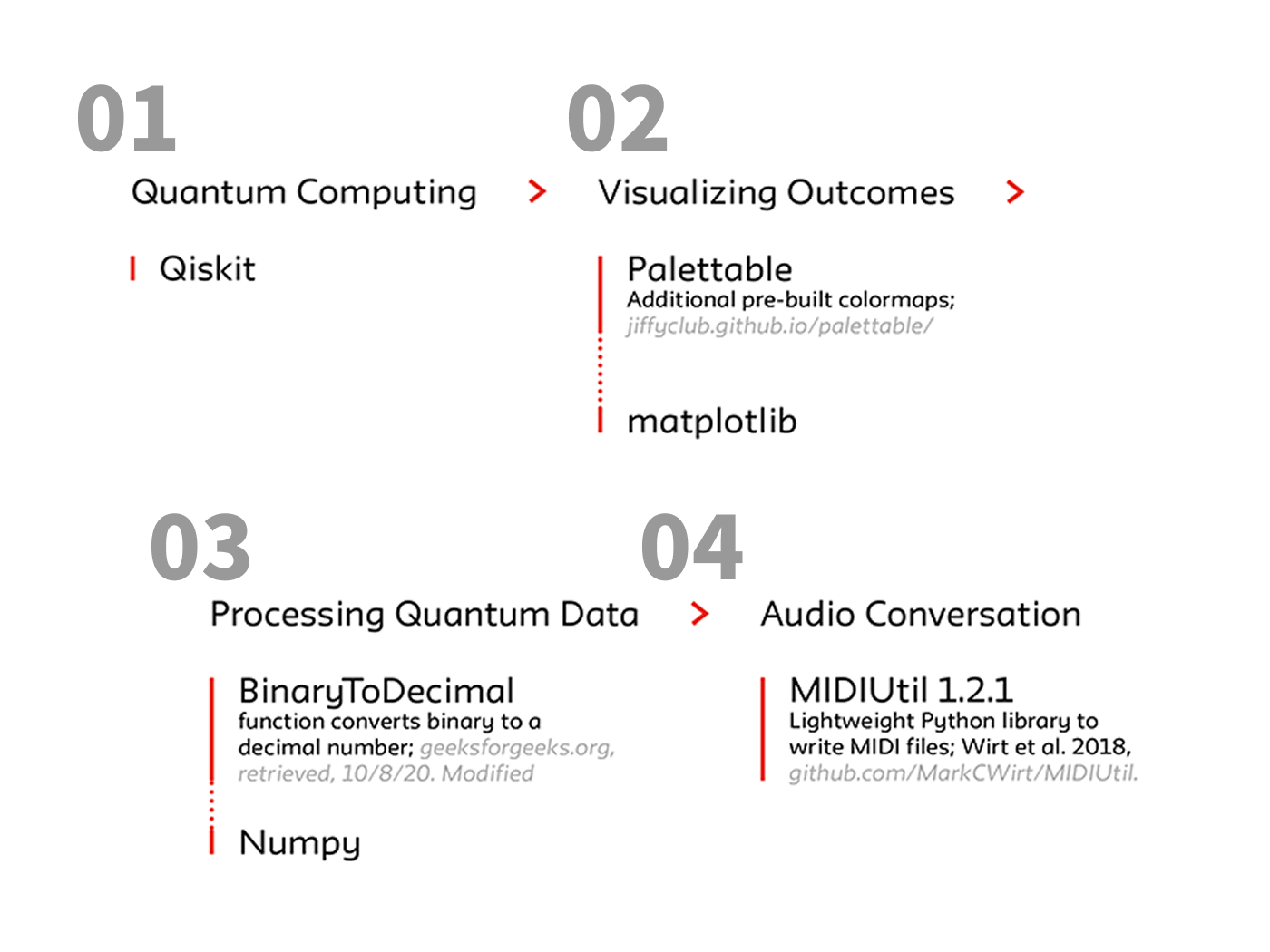
Python Libraries
The pipeline runs as a chain of Python libraries: quantum computing, visualising outcomes, processing the quantum data, then audio conversion. Everything downstream depends on that chain holding.
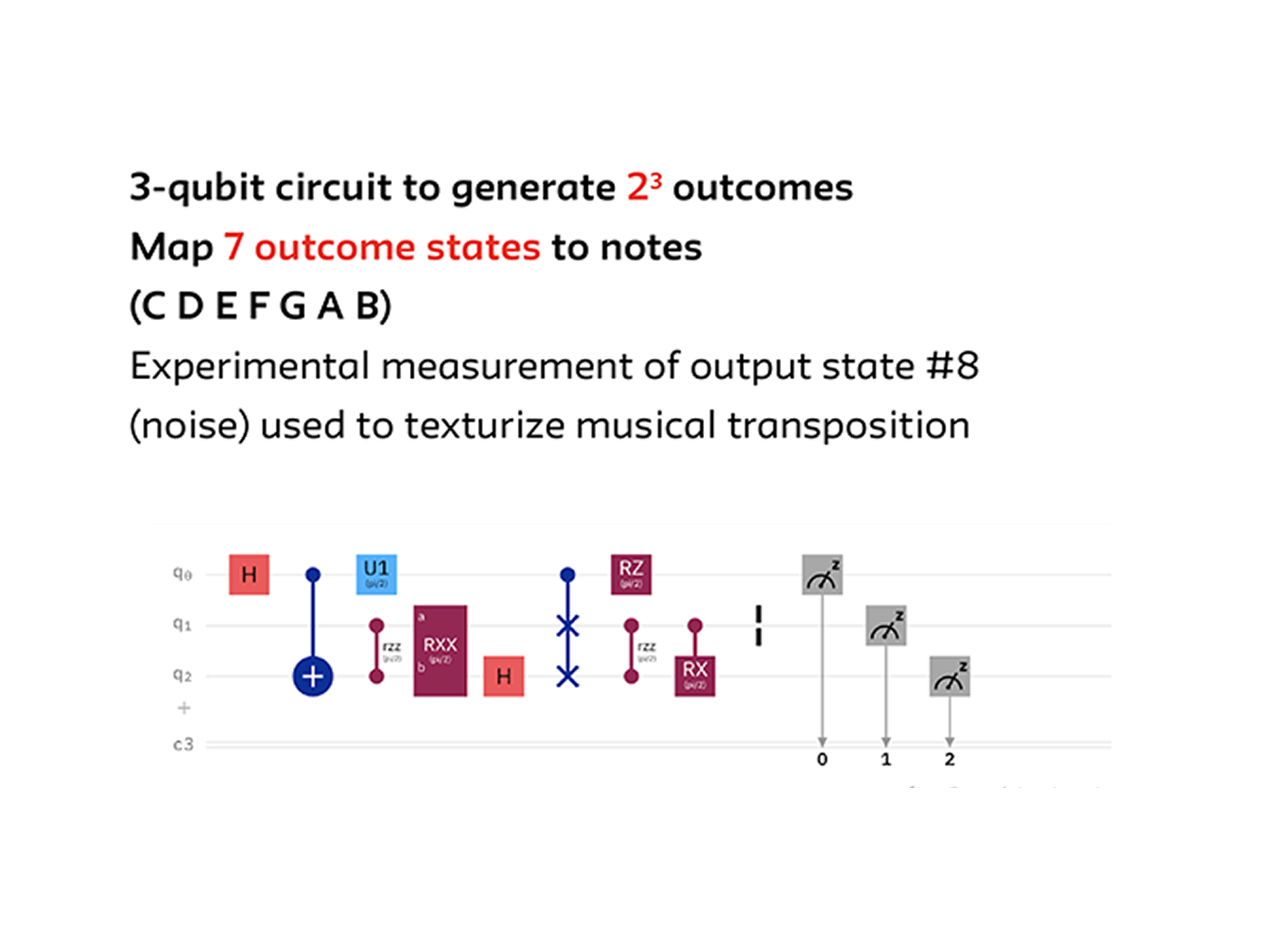
Diatonic Circuit
A three-qubit circuit generating 2³ outcomes. Seven of the outcome states are mapped to notes — C D E F G A B — and the experimental measurement of output state #8, read as noise, is used to texturise the musical transposition.
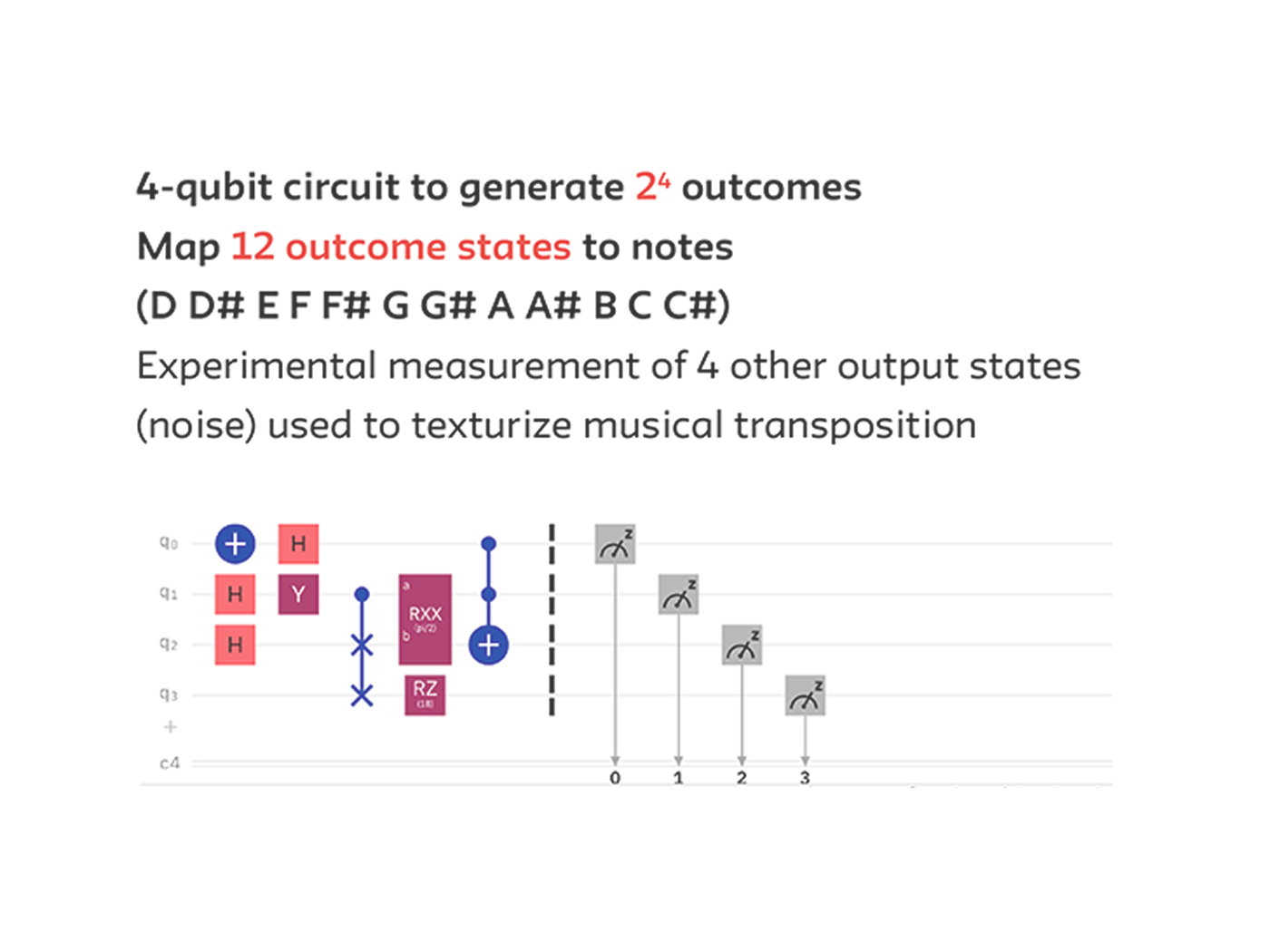
Chromatic Circuit
A four-qubit circuit generating 2⁴ outcomes. Twelve outcome states are mapped to notes — D D# E F F# G G# A A# B C C# — and the experimental measurement of the four other output states, again noise, texturises the transposition.
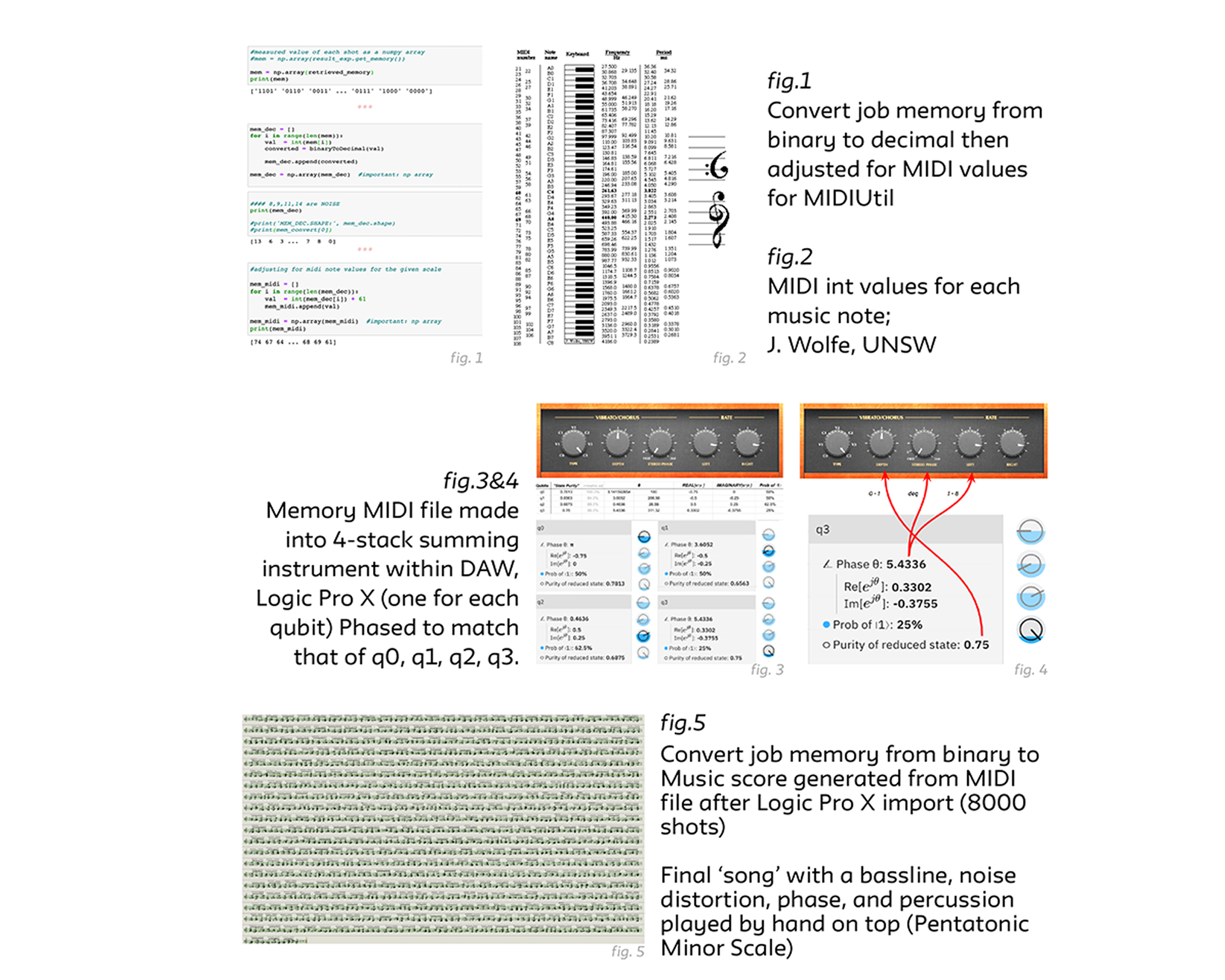
One work, played
Job memory is converted from binary to decimal and adjusted to MIDI values for MIDIUtil, using the integer value for each note set out by J. Wolfe at UNSW. The MIDI file becomes a four-stack summing instrument in Logic Pro X — one stack per qubit, phased to match q0, q1, q2 and q3 — and a score is generated from it after import, at 8,000 shots. The final song carries a bassline, noise distortion, phase and percussion played by hand on top, in a pentatonic mirror scale.
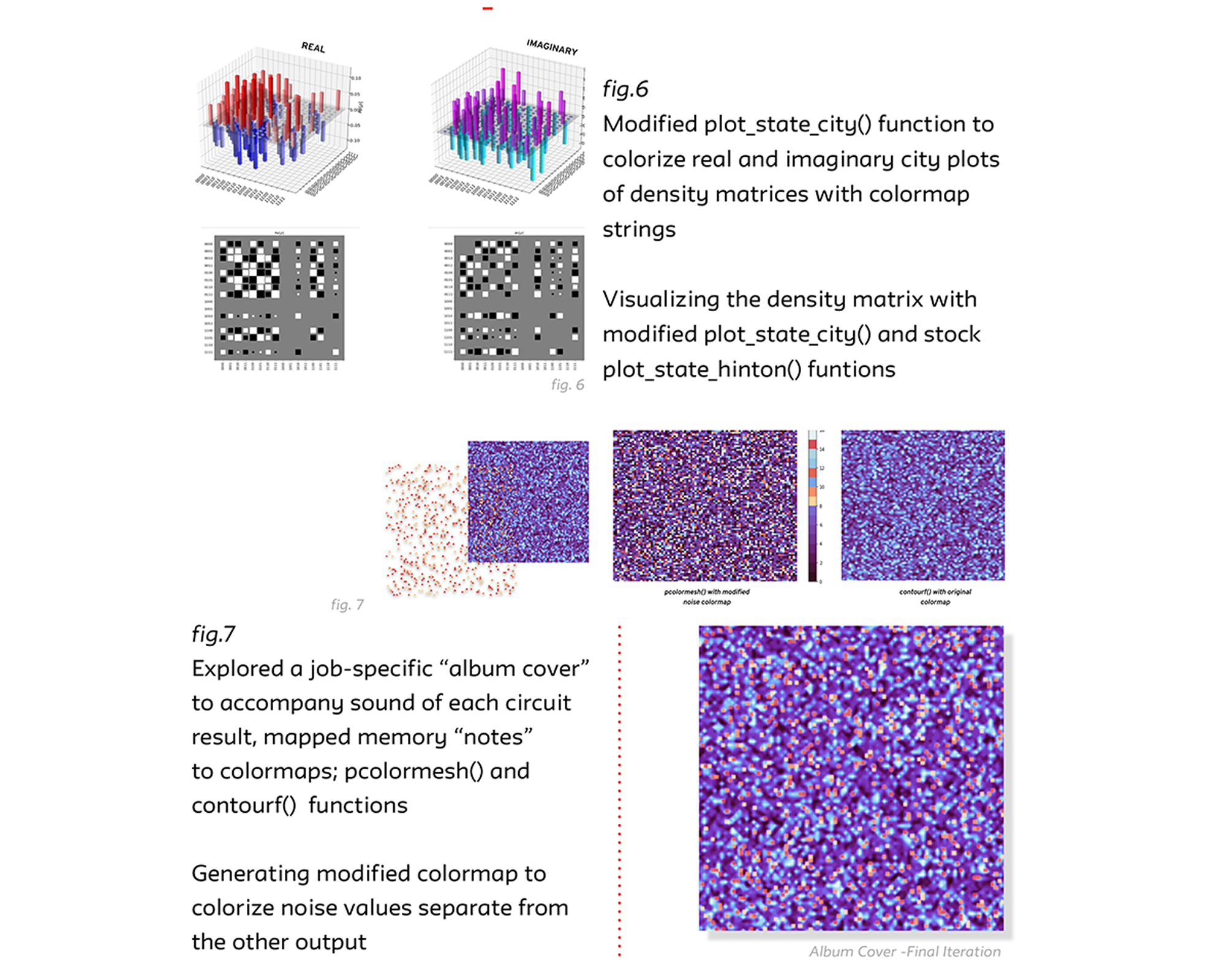
and the same work, seen
A modified plot_state_city() colourises the real and imaginary city plots of the density matrices with colormap strings, read alongside the stock plot_state_hinton(). Each job then gets its own album cover: the memory notes mapped to colormaps through pcolormesh() and contourf(), with a separate modified colormap so the noise values colour differently from everything else.
A song, and a cover made from the same job.
The final piece carries a bassline, noise distortion, phase and percussion played by hand over the quantum-derived material, in a pentatonic mirror scale. Each circuit result also produced its own image, generated from the same measurement that produced the sound.
Noise is material
The states left over once the notes are assigned aren't discarded. The eighth outcome in the diatonic circuit, and the four beyond the twelve notes in the chromatic one, are measured and used to texturise the transposition — and in the visuals they are given a modified colormap so they read separately from everything else.
One job, two senses
The same job memory produces both outputs. Converted to MIDI it becomes the score; read as a density matrix it becomes the image. Each album cover is generated from the measurement that generated its sound.
One stack per qubit
Inside Logic Pro X the MIDI file becomes a four-stack summing instrument, one stack for each qubit, phased to match q0 through q3. The structure of the circuit stays audible in the arrangement instead of collapsing into a single line.
Seven states became notes. The eighth became texture.
- Allon Goldberg
- Ege Uz
- Shawn Zhang
- Lin Zhou
- Sven Travis
- James WeaverIBM